The Elevator explicitly builds on the Escalator’s legacy. Korua combines lightweight construction with a new outline and a sidecut designed for touring mode. The useful question is whether that touring emphasis suits your usual approaches and descents.
Is the Korua Elevator Split 26/27 right for your tours?
Alpine splitters and active freeriders get hybrid carbon construction and 20 mm taper. The brief is precision without restricting the board to one snow type. In our own 26/27 test the Elevator rewards active edge pressure with high stability uphill and downhill – earning our Editors Selection.
What matters on the skin track?
Korua identifies improved grip on icy tracks as a goal of the new sidecut, together with a snow-repellent topsheet. That matters when comparing it with our older Escalator’s waxable surface. Do not transfer those maintenance instructions unchanged. Listed weights are 2.5 and 2.6 kg.
How do you choose length, width and stance?
Sizes are 157 and 162 cm with 258 and 260 mm waists. The size guide specifies EU 44 maximum and the more useful sole-length limit of 30.7 cm. Check real overhang in your binding position: boots with the same labelled size can differ in outer length.
How should boots, bindings and skins work together?
Boot fit, board width and lateral support work together. An oversized boot moves before your pressure reaches the edge. Match binding size to the actual boot and the highback to your weight. Playful descending need not mean a touring setup that collapses sideways. Practise the complete transition at home using the interface and screws you will actually carry. For skins, consider length, trimming and suitable nose and tail fittings. A general splitboard description does not approve every interface.
Read more in our Splitboard Gear Guide.
Which of our test experiences help you choose?
We tested the Korua Elevator Split ourselves, and it is right at the front of the pack: all-mountain 90/100, powder and speed 85/100 each, freestyle 70/100. It wants to be ridden actively – that is the Korua character we know. With the right pressure on the edge it is a superbly stable board on the descent and the climb, and an ideal companion for the Alps. The Elevator receives our Editors Selection. See the test summary for all ratings.
An additional report covers the predecessor. It explicitly concerns a 162 cm Korua Escalator weighing 2.8 kg; the following experience remains attached to the ridden Escalator.
Climbing was a strength: edge hold impressed in difficult passages, the board felt balanced and kick turns came easily. When snow accumulated on the waxed topsheet, the nose still lifted out of the track well. We liked the skin attachment and could fit the skins while the board remained in riding mode. These observations concern that board rather than confirming every current Elevator fitting.
Downhill, it was more versatile than its distinctive outline suggested. It floated well in powder and stayed controllable at speed on hardpack and rough snow. The short, firm tail provided support for drops and playful direction changes. Large skin-attachment holes occasionally delivered a direct spray of powder to the face.
The waxable topsheet required care: without wax it collected noticeable snow; suitable all-conditions wax reduced this substantially. That maintenance observation belongs to our Escalator. The Elevator has a different manufacturer-described snow-repellent surface, so we do not automatically recommend waxing it in the same way.
What has changed since 25/26 and earlier models?
Korua Shapes includes this version in its current regular range without assigning every change to a model year. This is our guide for the 26/27 season rather than a claim of a newly developed annual construction. Compare actual shape, dimensions, build and hardware with an earlier offer.
The Elevator has explicitly stated changes from the Escalator: new outline, touring sidecut and snow-repellent topsheet. The Escalator report therefore remains a predecessor comparison; our own test is what counts for the Elevator.
What is included in the price and what else do you need?
Budget for suitable bindings, their interface and skins in the complete setup price. Check actual package contents rather than assuming a complete touring setup from a product photograph. Korua offers model-specific skins separately. Match length and fittings; a skin for another Korua model is not compatible solely because the brand matches.
Which alternatives should you compare?
Compare Korua Quill Split and Never Summer Summit T3 Splitboard. The shape and usage differences are discussed above. A demo is especially useful when deciding between widths or constructions. Use your own boots and a familiar stance where possible, so you can identify what changed the feel instead of comparing two entirely different setups.
FAQ: What should you know before the first tour?
Does your Escalator test also test the Elevator?
No, these are two reports. We tested the Elevator ourselves; its scores are in the first test summary. The additional report concerns the predecessor Escalator in 162 cm at 2.8 kg and remains identified as a comparison.
Which length and width suit me?
Sizes are 157 and 162 cm with 258 and 260 mm waists. The size guide specifies EU 44 maximum and the more useful sole-length limit of 30.7 cm. Check real overhang in your binding position: boots with the same labelled size can differ in outer length.
Have you tested this board yourselves?
Yes. Our editorial ratings for the Elevator: all-mountain 90/100, powder and speed 85/100 each, freestyle 70/100, riding 85/100 and climbing 90/100. It wants to be ridden actively and is very stable with the right edge pressure. The board receives our Editors Selection.
How should boots, bindings and skins fit the board?
Boot fit, board width and lateral support work together. An oversized boot moves before your pressure reaches the edge. Match binding size to the actual boot and the highback to your weight. Playful descending need not mean a touring setup that collapses sideways. Practise the complete transition at home using the interface and screws you will actually carry. For skins, consider length, trimming and suitable nose and tail fittings. A general splitboard description does not approve every interface.
What is included in the price and what else do you need?
Budget for suitable bindings, their interface and skins in the complete setup price. Check actual package contents rather than assuming a complete touring setup from a product photograph. Korua offers model-specific skins separately. Match length and fittings; a skin for another Korua model is not compatible solely because the brand matches.
What differs from the previous season?
Korua Shapes includes this version in its current regular range without assigning every change to a model year. This is our guide for the 26/27 season rather than a claim of a newly developed annual construction. Compare actual shape, dimensions, build and hardware with an earlier offer.
Which sizes and specifications does the manufacturer list?
Sizes: 157, 162 cm. These are manufacturer specifications, not our own measurements. Pound figures also include rounded kilogram conversions; missing values remain unspecified.
| Length (cm) | 157 | 162 |
|---|---|---|
| Effective Edge (mm) *A* | 1180 | 1230 |
| Running Length (mm) | 1010 | 1060 |
| Nose Width (mm) *B* | 299 | 303 |
| Waist Width (mm) *C* | 258 | 260 |
| Tail Width (mm) *D* | 279 | 283 |
| Avg. Sidecut Radius (m) | 9.2 | 9.4 |
| Setback (mm) | 35 | 35 |
| Taper (mm) | 20 | 20 |
| Recommended Stance (cm) | 52 | 52 |
| Adjust. Stance Range (cm) | 47-57 | 47-57 |
| Board Weight (kg) | 2.5 | 2.6 |
| Switch Riding | No Problem | No Problem |
| Size (cm) | Max Boot Size (EU) | Max Boot Sole Length (cm) | Rider Weight Range (kg) | Max Rider Height (cm) |
|---|---|---|---|---|
| 157 | 44 | 30.7 cm | 55 - 90 kg | 188 cm |
| 162 | 44 | 30.7 cm | 65 - 95 kg | 195 cm |
Where do the data and images come from?
Korua Elevator Split – manufacturer page. Checked 19 October 2026. Product images and size charts come from the manufacturer. Test scores and the Escalator comparison come from our editorial 26/27 test notes.
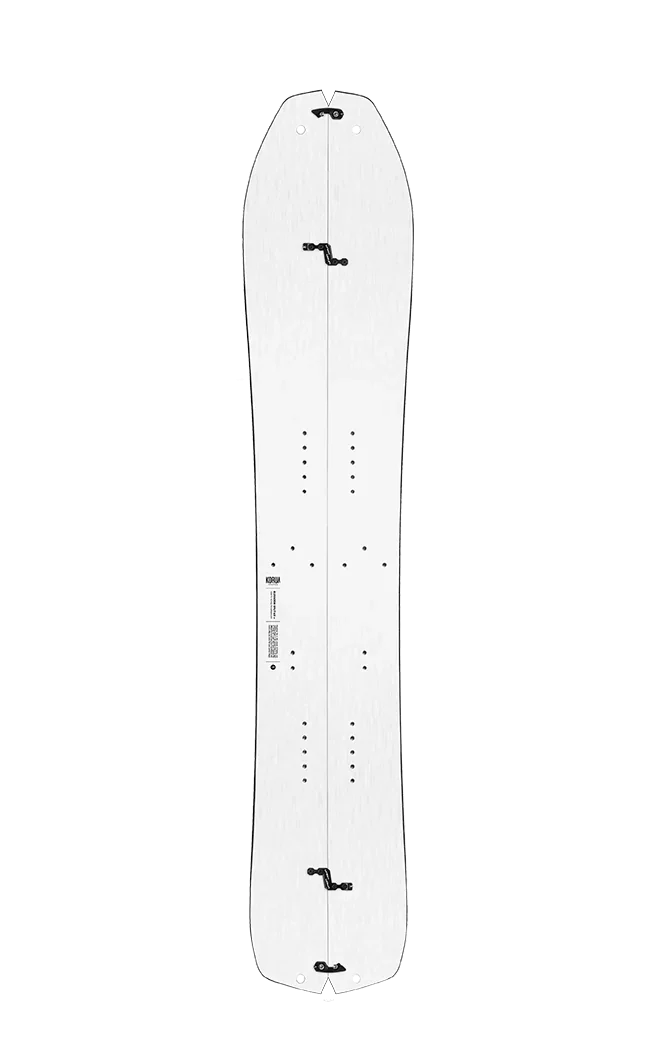
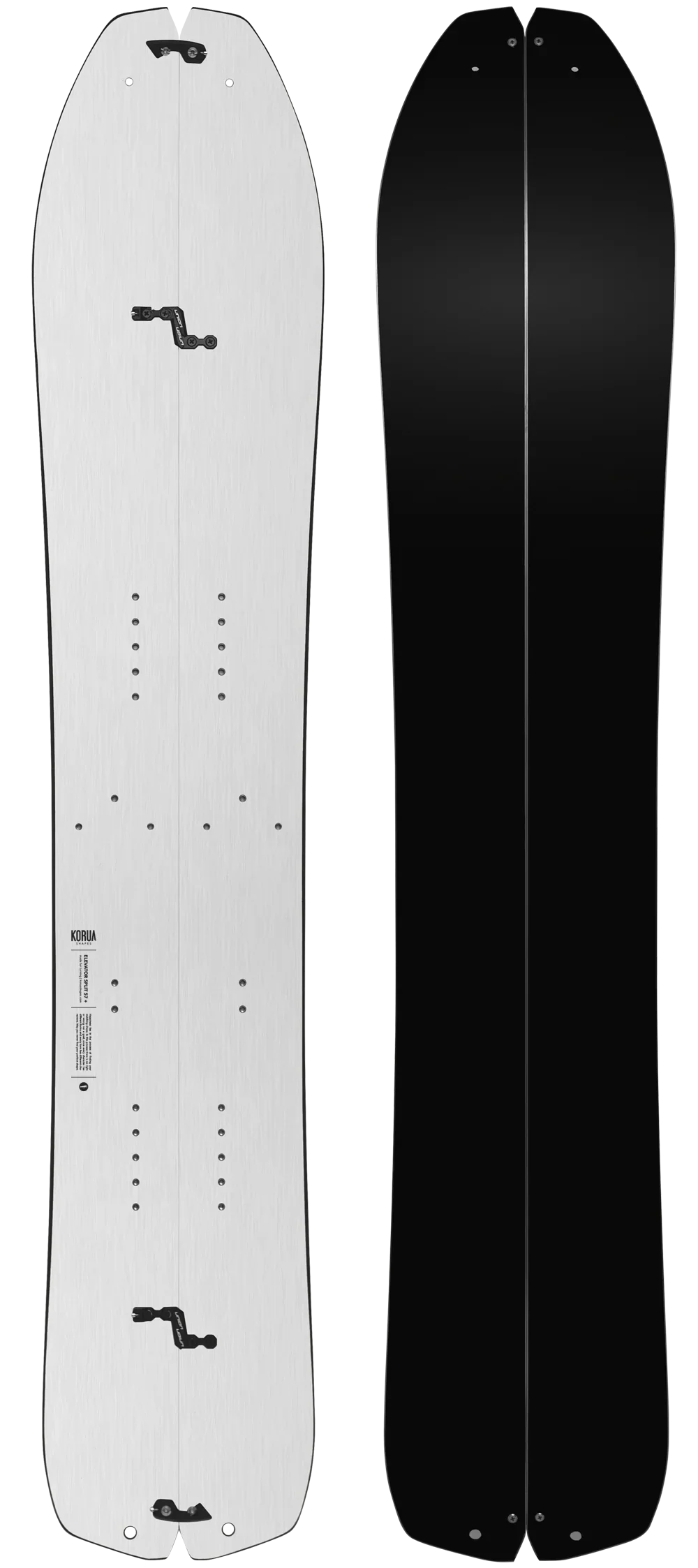
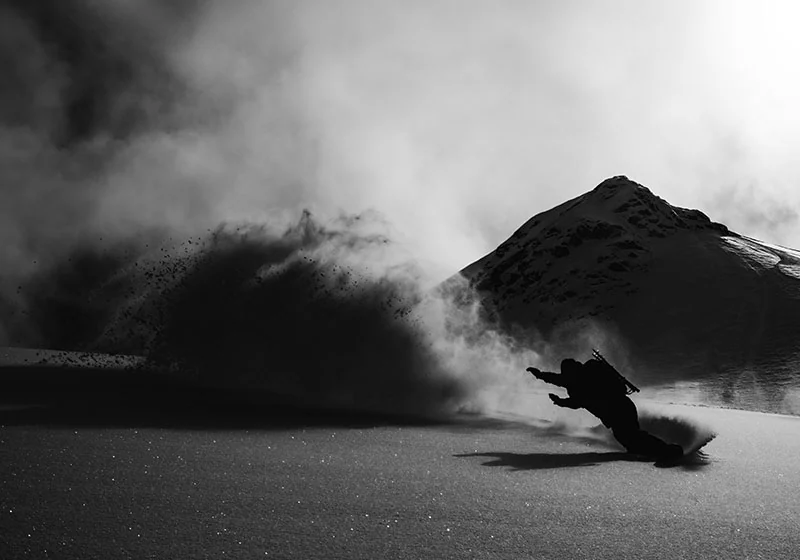
What does the board look like? (5 photos)
Show 1 more images